
I Asked 200,000 People How Much Emergency Care Actually Needs an Emergency Department. Here's What I Learned.
By Noah T. Kaufman, MD, Board-Certified Emergency Medicine · 8 min read · Emergency Medicine
An ER physician of 20+ years asked Reddit how much emergency care truly needs an emergency department. 200,000 views later, five lessons about the missing middle of acute care.
By Noah T. Kaufman, MD — Board-Certified Emergency Physician and Founder of KaufCare Advanced Urgent Care
I've practiced emergency medicine for more than 20 years.
Recently, I asked a question that has bothered me for a long time:
How much emergency care actually needs to happen in an emergency department?
I posted the question on Reddit expecting an interesting professional discussion. Instead, the conversation took off. More than 200,000 people viewed the original discussion, and hundreds of physicians, nurses, paramedics, patients and others weighed in.
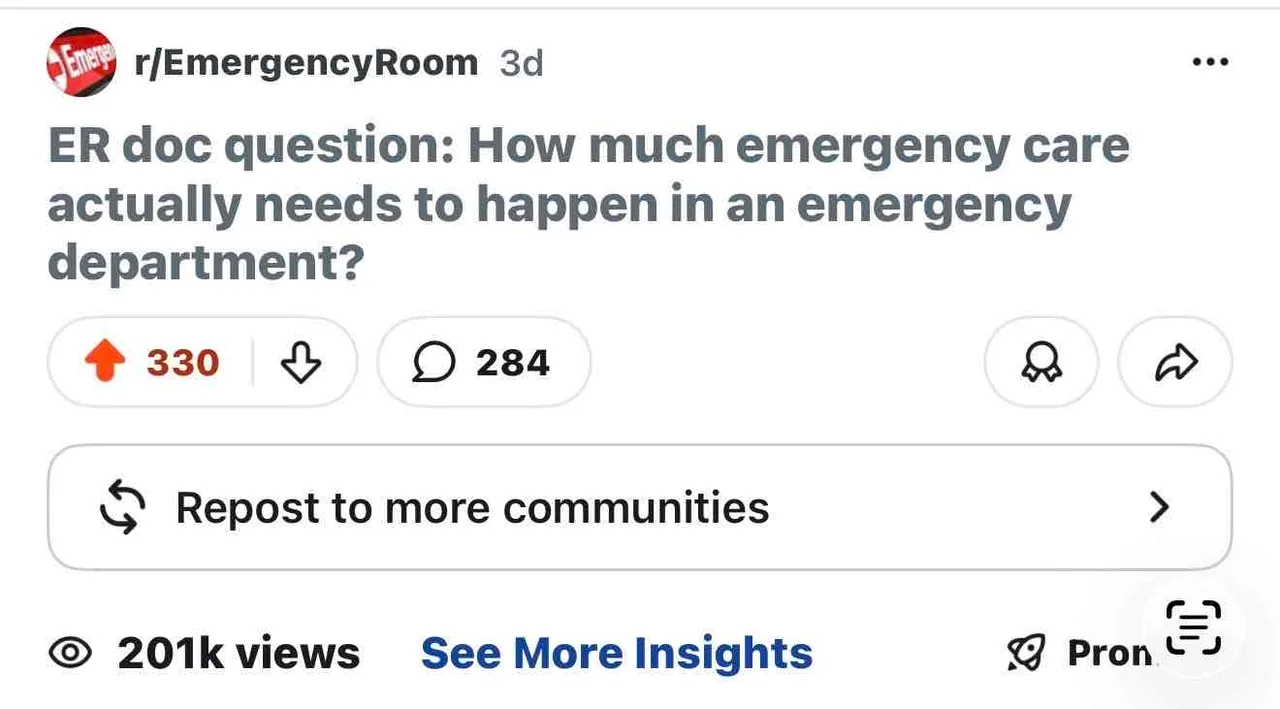
What interested me wasn't the number of views. It was how quickly the conversation exposed a fundamental problem in American acute care.
We ask patients to decide what level of medical care they need before they've been evaluated by someone qualified to make that decision.
The problem with “just go to the ER”
There are conditions that unquestionably belong in an emergency department.
Stroke. Major trauma. Heart attack. Shock. Severe respiratory distress. Uncontrolled bleeding. Serious neurologic emergencies. Critically ill children. Patients who may need emergency surgery, hospitalization, blood products, advanced imaging or intensive monitoring.
The emergency department is extraordinarily good at this.
But anyone who has spent significant time working in emergency medicine also knows that this isn't everything that walks through the door.
There is another enormous category of patients.
They need more than a typical primary-care office can provide. Often they need more than a conventional urgent care can provide.
But they don't necessarily need a hospital.
They may need stitches. An X-ray. IV fluids. Drainage of an abscess. Treatment of a fracture. Removal of a foreign body. An ultrasound. A joint reduction. A nerve block. An EKG. Migraine treatment. Wound care.
This is the “missing middle” of acute care.
And the Reddit discussion made clear just how complicated that middle actually is.
1. We expect patients to triage themselves
This was perhaps the most compelling theme in the discussion.
Our healthcare system asks a frightened person with abdominal pain, a sick child, a possible fracture or an unfamiliar neurologic symptom to decide whether they need primary care, urgent care, a freestanding emergency department or a hospital emergency department.
Sometimes even experienced clinicians cannot make that determination without examining the patient.
Yet somehow we expect patients to make it from their living rooms.
Several people described systems where patients instead enter through one door, are evaluated, and then directed to the appropriate level of care.
Conceptually, that makes far more sense.
Triage is a medical function. We shouldn't be surprised when patients struggle to perform it themselves.
2. “Urgent care” doesn't mean the same thing everywhere
Another theme was the extraordinary variation in urgent-care capability.
One facility may have physicians, X-ray, IV medications and significant procedural capability.
Another may handle respiratory infections, UTIs and minor injuries but refer anything more complicated to an emergency department.
From a patient's perspective, both buildings may simply say “Urgent Care” on the sign.
That creates another impossible task: patients aren't merely expected to understand their illness. They're expected to understand the capabilities of a facility they've probably never visited.
3. The dangerous patient doesn't always look dangerous
This is the strongest argument against simply diverting everyone who appears low-acuity away from emergency departments.
One contributor described a patient initially routed toward lower-acuity care for a headache who turned out to have a bleeding aneurysm.
That is emergency medicine in a nutshell.
Most headaches aren't subarachnoid hemorrhages. Most abdominal pain isn't a surgical catastrophe. Most dizzy patients aren't having posterior circulation strokes.
But “most” isn't good enough when you're evaluating the individual patient standing in front of you.
Any viable alternative to the emergency department therefore requires more than equipment.
It requires clinical judgment, appropriate risk stratification and a very low threshold to recognize when a patient has crossed the line into hospital-level care.
4. Hours are part of access
One commenter raised a deceptively simple issue: people don't necessarily go to emergency departments because they believe they are having emergencies.
Sometimes they go because the emergency department is open.
People work. They have children. They may not have paid time off. Their doctor's office may not have an appointment for several days.
Illness does not conveniently occur between 9 and 5.
An acute-care system that wants to reduce unnecessary emergency-department utilization cannot simply provide cheaper care.
It has to provide care when people actually need it.
5. Cost changes everything
There is also an uncomfortable reality that any discussion of emergency-department utilization has to acknowledge.
The emergency department is America's ultimate medical safety net.
Under EMTALA, emergency departments have obligations to evaluate patients regardless of their ability to pay. A cash-pay clinic—even an inexpensive one—cannot replace that function.
Nor should it.
But there is another group of patients caught in an equally strange position: people who can pay for medical care but reasonably don't want to expose themselves to thousands of dollars in hospital charges for a problem that may ultimately require stitches, an X-ray or IV fluids.
Transparent pricing doesn't solve America's healthcare-financing problems.
It does solve one smaller problem: allowing a patient to know what something costs before agreeing to it.
So what should exist between urgent care and the ER?
This question is partly why I founded KaufCare.
We are experimenting with a model of advanced urgent care in Denver: emergency-physician-led care, X-ray, ultrasound, EKG, IV therapy and greater procedural capability than a conventional urgent care, combined with transparent cash pricing.
The goal isn't to replace the emergency department.
And it certainly isn't to prove that every patient can be kept out of one.
Quite the opposite.
One of the most important decisions we make is recognizing the patient who doesn't belong with us.
The idea is simply that healthcare may need another layer.
Primary care serves one purpose.
Traditional urgent care serves another.
Advanced acute care may be able to occupy some of the enormous space between traditional urgent care and hospital emergency medicine.
And emergency departments should remain exactly what their name suggests: the place capable of caring for virtually anyone when the stakes are highest.
What 200,000 views actually told me
The Reddit discussion didn't prove that my answer is correct.
That's precisely what made it valuable.
People challenged the concept from nearly every direction: liability, economics, staffing, access, patient behavior, insurance, triage and the danger of missing serious disease.
Others described healthcare systems that already use versions of this model—sometimes placing urgent and emergency care together and triaging patients after they arrive rather than requiring them to choose beforehand.
After more than two decades in emergency medicine, I increasingly think the question isn't whether we need emergency departments.
We absolutely do.
The better question is:
Why have we made the emergency department the default answer for so many acute medical problems that don't ultimately require a hospital?
I don't think we've completely solved that problem.
But I think it's worth asking.
And apparently, a lot of other people do too.